


-
7:09
Watched
Describe the history and scope of pharmacology, the sources of drugs, and the nature and nomenclature of drugs.
-
29:31
Watched
Explain the molecular targets of drug action and the signal transduction mechanisms linked to each receptor family.
-
4:03
Watched
Analyse drug–receptor interactions quantitatively: concentration–response relationships, affinity and efficacy, types of antagonism, Schild analysis and radioligand binding.
-
24:36
Watched
Explain the mechanisms and consequences of receptor regulation, desensitisation and tolerance.
-
 14:25
Watched
Describe the absorption, distribution, metabolism and excretion of drugs, and apply pharmacokinetic parameters to calculate and interpret dosing regimens.
-
 8:05
Watched
Predict pharmacokinetic and pharmacodynamic drug interactions from their mechanisms.
-
 8:15
Watched
Explain transmission in the somatic, autonomic and enteric nervous systems, and predict the effects of drugs acting at cholinergic, adrenergic, ganglionic, neuromuscular and NANC sites.
Pharmacology
-
 3:37
Watched
Describe the history and scope of pharmacology, the sources of drugs, and the nature and nomenclature of drugs.
-
29:31
Watched
Explain the molecular targets of drug action and the signal transduction mechanisms linked to each receptor family.
-
4:03
Watched
Analyse drug–receptor interactions quantitatively: concentration–response relationships, affinity and efficacy, types of antagonism, Schild analysis and radioligand binding.
-
 7:43
Watched
Explain the mechanisms and consequences of receptor regulation, desensitisation and tolerance.
-
14:25
Watched
Describe the absorption, distribution, metabolism and excretion of drugs, and apply pharmacokinetic parameters to calculate and interpret dosing regimens.
-
 13:31
Watched
Predict pharmacokinetic and pharmacodynamic drug interactions from their mechanisms.
-
 15:42
Watched
Explain transmission in the somatic, autonomic and enteric nervous systems, and predict the effects of drugs acting at cholinergic, adrenergic, ganglionic, neuromuscular and NANC sites.
History and scope of pharmacology
-
3:37
Watched
Outline the major milestones in the history of pharmacology, from materia medica and the isolation of active plant principles to the receptor concept (Langley, Ehrlich) and modern biologics.
-
 11:23
Watched
Define pharmacology and distinguish its branches: pharmacodynamics, pharmacokinetics, pharmacotherapeutics, toxicology and pharmacogenomics.
Sources, nature and nomenclature of drugs
-
 12:29
Watched
Identify the sources of drugs (plant, animal, mineral, microbial, synthetic and semi-synthetic, biotechnological) with at least one example of each, including medicines derived from plants used in Ghanaian traditional medicine.
-
 11:46
Watched
Define drug, medicine, prodrug and placebo.
-
 12:36
Watched
Apply drug nomenclature correctly: chemical name, code name, generic (International Non-proprietary Name) and proprietary (brand) name; explain why generic prescribing is preferred.
Overview of drug discovery, development and regulation
-
 9:41
Watched
Outline the stages of drug development: discovery, preclinical testing, clinical trial phases I–IV and post-marketing surveillance.
-
 6:52
Watched
Describe the role of pharmacovigilance and of the national regulatory authority (Food and Drugs Authority, Ghana) in approving and monitoring medicines.
Targets of drug action and drug–receptor interaction
-
1:45
Watched
Name the four main classes of protein target (receptors, ion channels, enzymes, carriers/transporters) and give an example drug acting on each.
-
 2:45
Watched
Distinguish drugs acting on specific targets from those acting by non-specific physicochemical mechanisms (e.g. antacids, osmotic diuretics, chelating agents).
-
 14:56
Watched
Describe the forces involved in drug–receptor interaction (ionic, hydrogen, van der Waals, hydrophobic, covalent) and relate bond type to reversibility and duration of action.
Receptor families and second-messenger effector systems
-
 37:20
Watched
Describe the four receptor superfamilies (ligand-gated ion channels, G protein-coupled receptors, kinase-linked receptors, nuclear receptors): structure, time scale of response and a prototype example of each.
-
 0:38
Watched
Explain the G-protein cycle and the main effector pathways: Gs/Gi–adenylyl cyclase–cAMP–protein kinase A; Gq–phospholipase C–IP₃/DAG–Ca²⁺–protein kinase C; direct regulation of ion channels.
-
0:38
Watched
Describe the second messengers (cAMP, cGMP, IP₅, DAG, Ca²⁺, nitric oxide) and explain signal amplification.
Relation between binding and response: affinity and efficacy
-
 14:39
Watched
Apply the law of mass action and occupancy theory (Hill–Langmuir equation) to relate drug concentration to receptor occupancy.
-
 2:17
Watched
Define and distinguish affinity (KA/Kd), efficacy (intrinsic activity), potency (EC₅₀) and maximal effect (Emax).
-
2:14
Watched
Construct and interpret graded concentration–response curves (arithmetic and log scale) and quantal dose–response curves (ED₅₀, TD₅₀, LD₅₀, therapeutic index, margin of safety).
-
 5:39
Watched
Distinguish full agonists, partial agonists, inverse agonists and neutral antagonists; explain constitutive receptor activity.
-
 14:27
Watched
Explain spare receptors (receptor reserve) and their effect on agonist potency and on the action of irreversible antagonists.
Agonists, antagonists and types of antagonism
-
 3:28
Watched
Classify antagonism: reversible competitive, irreversible (non-equilibrium) competitive, non-competitive, allosteric, chemical, pharmacokinetic and physiological (functional), with an example of each.
-
 5:14
Watched
Explain the behaviour of a partial agonist given alone and in the presence of a full agonist.
Quantitative analysis of antagonism and radioligand binding
-
 13:26
Watched
Construct a Schild plot, determine pA₂ and interpret a slope of unity as evidence of simple competitive antagonism.
-
 15:42
Watched
Describe competition binding experiments (IC₅₀) and the conversion of IC₅₀ to Ki (Cheng–Prusoff relationship).
Receptor regulation, desensitisation and tolerance
-
 2:51
Watched
Define and distinguish desensitisation, tachyphylaxis and tolerance.
-
 16:12
Watched
Describe the mechanisms of desensitisation: receptor uncoupling (phosphorylation by GRKs, PKA, PKC; β-arrestin binding), sequestration/internalisation, down-regulation and degradation, mediator depletion, increased drug metabolism and physiological adaptation.
-
7:43
Watched
Distinguish homologous from heterologous desensitisation, with examples.
-
7:43
Watched
Explain receptor up-regulation and supersensitivity (e.g. rebound after abrupt β-blocker withdrawal) and their clinical implications.
Drug permeation and absorption
-
 0:16
Watched
Describe the mechanisms by which drugs cross membranes: passive diffusion, aqueous pores, carrier-mediated transport (SLC and ABC transporters, including P-glycoprotein) and endocytosis.
-
 5:36
Watched
Apply the Henderson–Hasselbalch equation to predict the ionisation of weak acids and bases and explain ion trapping.
-
 29:48
Watched
Compare the routes of drug administration (oral, sublingual, rectal, intravenous, intramuscular, subcutaneous, inhalational, topical, transdermal): advantages and limitations.
-
 6:47
Watched
Explain the factors affecting oral absorption; define bioavailability, bioequivalence and first-pass metabolism.
Drug distribution
-
 18:44
Watched
Describe body fluid compartments and the factors that determine drug distribution: blood flow, lipid solubility, plasma-protein and tissue binding, and barriers (blood–brain barrier, placenta).
-
 29:39
Watched
Define apparent volume of distribution, calculate it (Vd = dose / C₀) and interpret large and small values.
-
29:39
Watched
Explain the clinical relevance of plasma-protein binding (albumin, α₁-acid glycoprotein) and of displacement interactions.
Drug metabolism (biotransformation)
-
 28:06
Watched
Describe phase I (oxidation, reduction, hydrolysis) and phase II (glucuronidation, sulfation, acetylation, glutathione conjugation, methylation) reactions and the properties of their products.
-
 13:31
Watched
Explain the role of the cytochrome P450 system (CYP3A4, 2D6, 2C9, 2C19, 1A2) and name common enzyme inducers and inhibitors.
-
13:31
Watched
Explain the time course and consequences of enzyme induction and inhibition.
-
 1:50
Watched
Describe prodrugs, and active and toxic metabolites (e.g. paracetamol and NAPQI).
-
21:46
Watched
Outline the effects of genetics (acetylator status, CYP2D6 polymorphism), age and liver disease on drug metabolism.
Drug excretion
-
 0:40
Watched
Describe renal excretion: glomerular filtration, active tubular secretion and passive tubular reabsorption; explain the effect of urinary pH (e.g. urinary alkalinisation in salicylate poisoning).
-
 3:00
Watched
Describe biliary excretion and enterohepatic circulation, and minor routes (lungs, breast milk).
-
 16:47
Watched
Define renal clearance and relate it to glomerular filtration rate.
Quantitative pharmacokinetics and dosing
-
 21:38
Watched
Define clearance, elimination rate constant, half-life (t½ = 0.693 × Vd / CL) and area under the curve.
-
21:38
Watched
Distinguish first-order from zero-order (saturation) kinetics, with examples (ethanol, phenytoin, high-dose aspirin).
-
 5:07
Watched
Interpret plasma concentration–time curves for an intravenous bolus, an oral dose and a constant infusion using a one-compartment model.
-
 10:14
Watched
Explain steady state, accumulation and the time to reach steady state (about 4–5 half-lives).
-
 24:19
Watched
Calculate loading and maintenance doses from Vd, CL, target concentration, dosing interval and bioavailability.
-
 6:20
Watched
Describe the principles of therapeutic drug monitoring and the significance of a narrow therapeutic index.
Drug interactions
-
 4:14
Watched
Classify drug interactions as pharmaceutical, pharmacokinetic (absorption, distribution, metabolism, excretion) or pharmacodynamic (additive, synergistic, antagonistic).
-
28:06
Watched
Predict clinically important interactions from their mechanism (e.g. enzyme inducers with oral contraceptives, CYP inhibitors with warfarin, probenecid with penicillin).
Organisation of the efferent nervous system
-
 31:00
Watched
Compare the somatic efferent, autonomic (sympathetic and parasympathetic) and enteric nervous systems: anatomy, transmitters and receptors at each junction.
-
 39:23
Watched
Describe the effects of sympathetic and parasympathetic activation on the major effector organs (eye, heart, blood vessels, bronchi, gut, bladder, glands) and the concept of dominant tone.
Ganglionic transmission and ganglion-blocking drugs
-
 16:53
Watched
Describe nicotinic (NN) transmission in autonomic ganglia.
-
 6:54
Watched
Describe ganglion stimulants (nicotine) and blockers (hexamethonium, trimetaphan, mecamylamine), and predict their effects on each organ from its dominant autonomic tone.
Cholinergic transmission and drugs
-
 9:09
Watched
Describe the synthesis (choline acetyltransferase), vesicular storage, release and hydrolysis (acetylcholinesterase, butyrylcholinesterase) of acetylcholine.
-
 4:46
Watched
Identify the sites for drug action at the cholinergic synapse with an example drug for each: choline uptake (hemicholinium), vesicular storage (vesamicol), release (botulinum toxin), hydrolysis (reversible and irreversible anticholinesterases) and receptors.
-
 13:11
Watched
Classify muscarinic receptors (M₁–M₅) by location, G-protein coupling, effector mechanism and function.
-
 7:07
Watched
Describe muscarinic agonists (acetylcholine, methacholine, carbachol, bethanechol, pilocarpine): effects and uses.
-
 8:10
Watched
Describe muscarinic antagonists (atropine, hyoscine, ipratropium, tropicamide, oxybutynin): effects, uses and adverse effects; recognise anticholinergic toxicity.
-
 14:01
Watched
Describe organophosphate poisoning and its management with atropine and pralidoxime.
Adrenergic transmission and drugs
-
 11:53
Watched
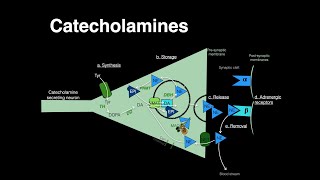
Describe noradrenaline synthesis (tyrosine hydroxylase as the rate-limiting step), vesicular storage (VMAT), release and inactivation (uptake 1/NET, uptake 2, MAO, COMT).
-
 17:51
Watched
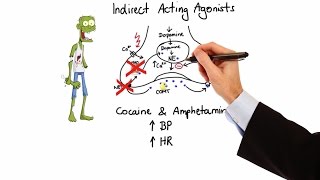
Identify pre- and post-junctional sites for drug action: α-methyltyrosine, reserpine, neuron-blocking drugs (guanethidine), α₂-autoreceptors, uptake inhibitors (cocaine, tricyclic antidepressants), and MAO and COMT inhibitors.
-
0:44
Watched
Explain false transmitters (methyldopa → α-methylnoradrenaline) and indirectly acting sympathomimetic amines (tyramine, amphetamine, ephedrine), including the tyramine–MAOI interaction.
-
 10:20
Watched
Classify adrenoceptors (α₁, α₂, β₁, β₂, β₃) by location, G-protein coupling, second messenger and response.
-
1:58
Watched
Relate receptor selectivity to representative agonists (adrenaline, noradrenaline, isoprenaline, phenylephrine, clonidine, dobutamine, salbutamol) and antagonists (prazosin, phentolamine, propranolol, atenolol, labetalol) at an introductory level.
Somatic efferent transmission: the neuromuscular junction
-
 31:33
Watched
Describe transmission at the skeletal neuromuscular junction (NM receptors, end-plate potential).
-
 16:21
Watched
Distinguish non-depolarising (tubocurarine, atracurium, rocuronium) from depolarising (suxamethonium) neuromuscular blockers, including phase I and phase II block and reversal (anticholinesterases, sugammadex).
Non-adrenergic, non-cholinergic (NANC) and purinergic transmission

Share this course
Send it to your class on WhatsApp.
WhatsAppVideos play from YouTube. Watching is free for everyone. YouTube Terms of Service · Google Privacy Policy