The revision that feels best is the revision that works worst
Part 1 of The Confidence Trap
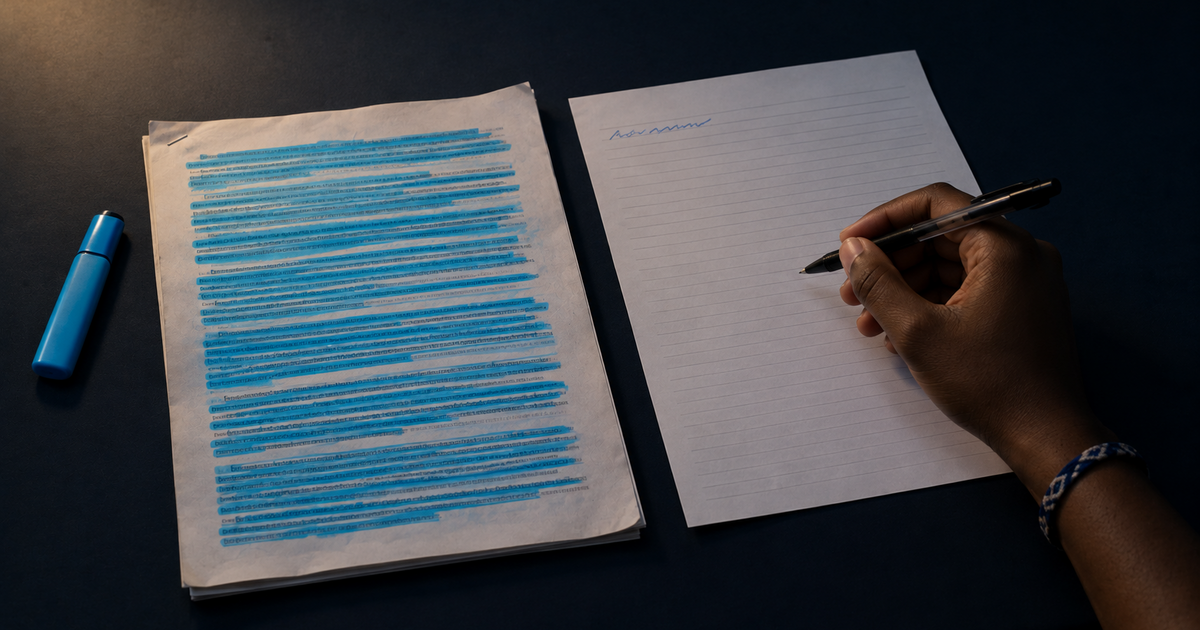
You know the evening. The handout is open, the highlighter is out, and by the third pass the pages are familiar enough that you can see where each paragraph sits before you turn to it. It feels like progress, because it is: you are visibly better at reading that handout than you were two hours ago. Then the mid-sem is a week later, and the page you could picture so clearly is gone.
This is not a memory problem. It is a measurement problem. The thing you were tracking during the session — how easy the material felt — is not the thing the exam measures, and the two come apart in a way that is now very well documented. This series is about that gap, and this first part is about the shape of it.
Performance is not learning
Nicholas Soderstrom and Robert Bjork's 2015 review in Perspectives on Psychological Science draws the distinction that everything else here rests on. Performance is what you can observe during a study session: how quickly you get through a page, how fluent the material feels, how many practice questions you get right while the notes are still open. Learning is the relatively permanent change — what is still there a week or a month later, in a different room, under a clock. Performance is easy to see and learning is not, so we steer by performance. The problem is that the two are not merely different. Across decades of experiments they move in opposite directions: the conditions that push performance up during the session — rereading, doing all the questions on one topic in a block, studying in one long sitting — reliably produce less learning than the conditions that make the session feel harder.
Bjork's name for those harder conditions is desirable difficulties. Spacing your study out, mixing topics, and above all trying to recall something rather than looking at it again, all make the session slower and less comfortable and the memory more durable. The difficulty is not a cost you pay for the learning. It is the learning.
The experiment where the feeling lies
The cleanest demonstration is Henry Roediger and Jeffrey Karpicke's 2006 experiment in Psychological Science. Undergraduates learned a short prose passage in four sessions. One group read it in all four — by the end they had been through it 14.2 times on average. Another group read it once and spent the other three sessions writing down everything they could remember, with no feedback and no second look at the text. They had read it 3.4 times.
Five minutes after the last session, the rereaders were ahead: 83% of the passage recalled, against 71%. If you had tested both groups that evening you would have concluded rereading works. A week later the rereaders recalled 40% and the group that had tested itself recalled 61%. Over the week, the rereaders forgot 52% of what they had known; the tested group forgot 14%.
Then the detail that gives this series its name. Before they left, every student rated how well they expected to remember the passage in a week. The rereaders were the more confident group — 4.8 on a seven-point scale, against 4.0. The method that felt best was the one that worked worst, and the students could not feel the difference. Nobody could. That is the point: the feeling is not a faulty instrument you can recalibrate with practice. It is measuring the wrong thing.
And most of us are in the rereading group
Three years later Karpicke, Andrew Butler and Roediger asked 177 undergraduates what they actually do when they study, in Memory. Asked to list their strategies, 84% named rereading their notes or textbook, and 55% ranked it as the one they use most. Eleven per cent — 19 students — listed testing themselves. Two ranked it first.
The second question was more pointed. Imagine you have read a textbook chapter once for an upcoming exam. Would you rather go back and reread it, try to recall the material from it, or do something else? Fifty-seven per cent said reread. Eighteen per cent said recall. Put the other way: 78% of students, having read a chapter once, would not test themselves on it.
And of the few who would, most gave a reason that quietly undoes the benefit. They said they would test themselves to find out what they did not know, so they could go back and study it. Only 8% of all the students said they would do it because recalling something helps you remember it. Testing to check is a fine thing to do, but it comes with a habit attached: once you have checked something and found you know it, you drop it. Karpicke and Roediger measured what that costs in Science in 2008. Students who dropped a word from further recall once they had produced it correctly remembered about 35% of the list a week later. Students who kept recalling words they already knew remembered about 80%. Same words, same total time, and every group had predicted about 50%.
So the picture is this. Most students reread. Rereading is the method that feels best and produces the least. The minority who test themselves mostly do it to check, and checking leads them to stop at exactly the point where the benefit starts. None of them can feel any of this happening, and the survey found no sign that the strongest students were exempt.
What to do tonight
Three things, none of which takes longer than what you do now.
After the first read, shut it and recall. Not skim it again — close the handout and write down what you remember, or answer questions on it with the notes shut. This is the single highest-return change in the literature, and it is the one 78% of students say they would not make. Then reread only the parts the attempt showed were missing. You now know which parts; you did not before.
Treat fluency as a warning. When the pages feel easy and familiar, that is the moment to test, not the moment to stop. Ease is a fact about the page in front of you. It says nothing about whether the page will be there when it is not in front of you.
Keep the ones you got right. Checking-and-dropping is how a student who does test themselves ends up in the 35% group. Keep something in rotation until you have recalled it on two different days.
That is enough for one evening. The full method — what to read first, how to space the return visits, what to do with a wrong answer — is in How to learn with practice questions, and the rest of this series takes the gap between feeling ready and being ready one piece at a time. The next part is about the moment the gap shows: you understood the lecture, and still failed the quiz.
Sources
- Soderstrom, N. C., & Bjork, R. A. (2015). Learning versus performance: An integrative review. Perspectives on Psychological Science, 10(2), 176–199. bjorklab.psych.ucla.edu
- Bjork, E. L., & Bjork, R. A. (2011). Making things hard on yourself, but in a good way: Creating desirable difficulties to enhance learning. In Psychology and the Real World (pp. 56–64). Worth. bjorklab.psych.ucla.edu
- Roediger, H. L., & Karpicke, J. D. (2006). Test-enhanced learning: Taking memory tests improves long-term retention. Psychological Science, 17(3), 249–255. journals.sagepub.com
- Karpicke, J. D., Butler, A. C., & Roediger, H. L. (2009). Metacognitive strategies in student learning: Do students practise retrieval when they study on their own? Memory, 17(4), 471–479. learninglab.psych.purdue.edu
- Karpicke, J. D., & Roediger, H. L. (2008). The critical importance of retrieval for learning. Science, 319(5865), 966–968. science.org
Questions people ask
If rereading my notes feels like it is working, why isn't it?
Because what you are feeling is fluency, not memory. The second time through a page the words are familiar and easy, and familiarity feels like knowing. But recognising a sentence when it is in front of you and producing it when it is not are different acts, and an exam only asks for the second. In Roediger and Karpicke's 2006 experiment the students who reread were the most confident group and remembered the least a week later.
What should I do after reading a chapter once?
Shut it and try to recall it — write down what you remember, or answer questions on it with the notes closed. Not to check yourself, but because the act of recalling is what makes the memory last. Then read again only the parts the attempt showed were missing. Do not simply read the whole chapter a second time.
Once I can recall something, can I drop it and move on?
Not yet. In Karpicke and Roediger's 2008 experiment, students who dropped a word from further testing once they had recalled it remembered about 35% of the list a week later; students who kept recalling it remembered about 80%. Keep something in the rotation until you have recalled it correctly on at least two separate days.
Read next
How to learn with practice questions
Practice questions are not the check you run after studying; they are the studying. Students who answered from memory remembered about half as much again a week later as re-readers - and predicted the opposite. Read once, shut the notes, answer, read the explanation, come back a few days later.
Campus Ghana Part 2
Quiz, interim assessment, mid-sem: which of these can actually sink you
A bad quiz or mid-sem costs a few marks and raises what you need in the exam. That is all it does: continuous assessment is 30 or 40 per cent of a course. What sinks a course is missing the exam, missing too many classes or skipping a course requirement.