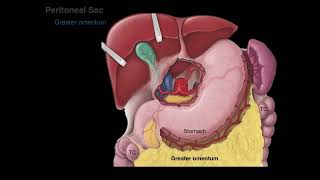


Anatomy (Gross Anatomy)
1.3 Peritoneum (Gross Anatomy)
-
24:42
Watched
1.3.1 Define parietal and visceral peritoneum, dorsal and ventral mesentery, and foregut, midgut and hindgut, and distinguish intraperitoneal from retroperitoneal organs.
-
8:33
Watched
1.3.2 Explain the developmental origin and attachments of the falciform ligament, lesser and greater omentum, gastrosplenic and lienorenal ligaments.
-
30:28
Watched
1.3.3 Describe the lesser sac, the boundaries of the epiploic foramen and the subphrenic and hepatorenal spaces, and explain their significance in the spread of infection and fluid.
1.4 Stomach and duodenum (Gross Anatomy)
-
23:48
Watched
1.4.1 Identify the parts of the stomach (cardia, fundus, body, pyloric antrum, pylorus, greater and lesser curvatures) and the four parts of the duodenum.
-
 8:58
Watched
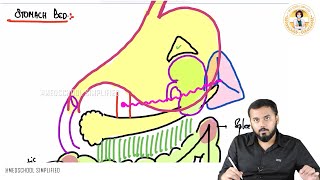
1.4.2 Describe the relations of the stomach, including the stomach bed (pancreas, left kidney, spleen, splenic artery, transverse colon, greater and lesser omentum, lesser sac).
-
 18:31
Watched
1.4.3 Describe the relations of each part of the duodenum, including the head of the pancreas, bile duct, major duodenal papilla, aorta, superior mesenteric vessels, portal vein and right kidney.
-
 21:15
Watched
1.4.4 Describe the arterial supply of the stomach and duodenum from the coeliac trunk and superior mesenteric artery, and explain why a posterior duodenal ulcer can erode the gastroduodenal artery.
-
 4:49
Watched
1.4.5 Explain the lymphatic routes by which gastric cancer spreads and name the main groups of lymph nodes involved.
1.5 Intestines: small and large (Gross Anatomy)
-
 5:59
Watched
1.5.1 Distinguish the jejunum from the ileum by wall thickness, vasa recta, arterial arcades, mesenteric fat and Peyer’s patches.
-
 5:13
Watched
1.5.2 Describe the distinguishing features of the large intestine (taeniae coli, haustra, appendices epiploicae) and the position, relations and peritoneal attachments of the caecum, appendix, colon and rectum.
-
 8:28
Watched
1.5.4 Describe the positions of the appendix and the surface marking of its base (McBurney’s point).
Share this course
Send it to your class on WhatsApp.
WhatsAppVideos play from YouTube. Watching is free for everyone. YouTube Terms of Service · Google Privacy Policy