


Pharmacology
Drug distribution
-
29:39
Watched
Define apparent volume of distribution, calculate it (Vd = dose / C₀) and interpret large and small values.
-
18:44
Watched
Describe body fluid compartments and the factors that determine drug distribution: blood flow, lipid solubility, plasma-protein and tissue binding, and barriers (blood–brain barrier, placenta).
-
29:39
Watched
Explain the clinical relevance of plasma-protein binding (albumin, α₁-acid glycoprotein) and of displacement interactions.
Drug excretion
-
16:47
Watched
Define renal clearance and relate it to glomerular filtration rate.
-
 3:00
Watched
Describe biliary excretion and enterohepatic circulation, and minor routes (lungs, breast milk).
-
 0:40
Watched
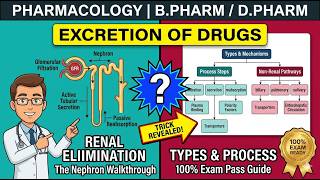
Describe renal excretion: glomerular filtration, active tubular secretion and passive tubular reabsorption; explain the effect of urinary pH (e.g. urinary alkalinisation in salicylate poisoning).
Drug metabolism (biotransformation)
-
 28:06
Watched
Describe phase I (oxidation, reduction, hydrolysis) and phase II (glucuronidation, sulfation, acetylation, glutathione conjugation, methylation) reactions and the properties of their products.
-
 1:50
Watched
Describe prodrugs, and active and toxic metabolites (e.g. paracetamol and NAPQI).
-
 13:31
Watched
Explain the role of the cytochrome P450 system (CYP3A4, 2D6, 2C9, 2C19, 1A2) and name common enzyme inducers and inhibitors.
-
 13:31
Watched
Explain the time course and consequences of enzyme induction and inhibition.
-
21:46
Watched
Outline the effects of genetics (acetylator status, CYP2D6 polymorphism), age and liver disease on drug metabolism.
Drug permeation and absorption
-
 5:36
Watched
Apply the Henderson–Hasselbalch equation to predict the ionisation of weak acids and bases and explain ion trapping.
-
 29:48
Watched
Compare the routes of drug administration (oral, sublingual, rectal, intravenous, intramuscular, subcutaneous, inhalational, topical, transdermal): advantages and limitations.
-
 0:16
Watched
Describe the mechanisms by which drugs cross membranes: passive diffusion, aqueous pores, carrier-mediated transport (SLC and ABC transporters, including P-glycoprotein) and endocytosis.
-
 6:47
Watched
Explain the factors affecting oral absorption; define bioavailability, bioequivalence and first-pass metabolism.
Share this course
Send it to your class on WhatsApp.
WhatsAppVideos play from YouTube. Watching is free for everyone. YouTube Terms of Service · Google Privacy Policy